Blog22 December 2025

It’s now nearly seven years since TASO was established – with a mission to improve lives through evidence-informed practice in higher education. While we have certainly come a long way – the sector is producing many more robust evaluations of its activities – we know there are still challenges to delivering effective evaluation and learning what works best for addressing the inequalities that students experience.
At the same time, we’ve achieved some critical successes. The need for robust evaluation is today widely agreed, with the conversation now evolving to how this more established system of evaluation can lead to systemic, meaningful change.
As evidence that evaluation is seen as central to changing outcomes in higher education, it also featured in the government’s education and skills white paper, published in October. We welcomed the paper’s calls to further strengthen evaluation in access and participation plans, ‘making use of the rigorous evidence-based work’ of TASO. And we pushed for the paper’s proposals to be assessed in terms of their impact on the longstanding inequalities in higher education.
In 2025, we’ve continued to develop and provide evaluation guidance and resources; commission evaluations of interventions designed to reduce equality gaps; commission and develop evidence syntheses; and deliver evaluation training to practitioners and evaluators.
.
Convening the sector
Our annual conference in May convened over 120 delegates from across the sector to discuss this ongoing challenge, learn from peers and experts, and develop evaluation expertise through workshops and interactive sessions.
We must break the link between background and success, and break the persistent gaps that hamper the life chances of too many people in our society.”
Opening the conference, Jacqui Smith, Minister of State for Skills, said: “We must break the link between background and success, and break the persistent gaps that hamper the life chances of too many people in our society.”
She added that people’s aspirations should be supported “…regardless of their background, where they live and their personal circumstances”.
This articulation of our mission drew together the themes of our conference: strengthening evaluation, peer learning and focusing on the overarching vision of providing the opportunity for everyone to access, succeed and thrive in higher education.
We’ve also continued to develop our Sector Network this year, with 150 members from evaluation and widening-participation specialisms – creating further opportunities for knowledge sharing and peer learning.
Also this year, we’ve hosted 14 training sessions and events, ranging from theory-based evaluation and data visualisation, through to implementation and process evaluation, and developing theories of change. We’ve delivered our training and events to over 1,300 participants, representing more than 300 organisations.
Topics, tools, templates and theories of change
Our revamped website launched at the end of 2024, involving a full content audit, rebrand and resource categorisation. The result is a restructured site, with the Insights and evaluation library at its core – which is now the most visited area of the website, providing easy access to our tools, templates, reports and projects.
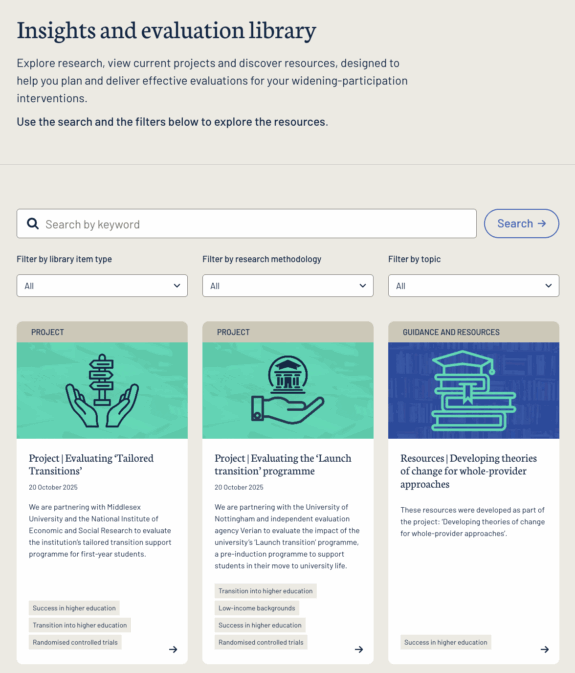
Insights and evaluation library
Another development for this year is the Theory of Change Builder, an online tool launched in October. It is designed to help people create theories of change to plan and evaluate interventions. Users can enter activities and outcomes and plot causal pathways to show the desired impact of interventions, leading to a fully designed theory of change. This is one of the most viewed online areas, demonstrating the demand for the tool.
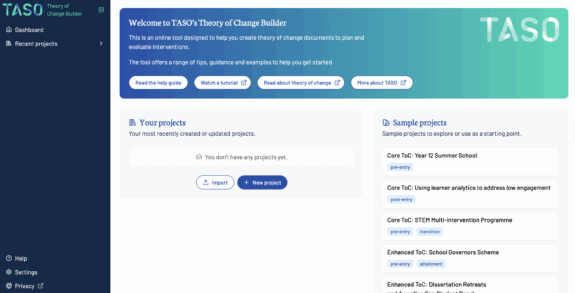
Theory of Change Builder
Our Interactive Technical Guides, hosted on GitHub, are a collection of TASO resources to support your evaluation, data visualisation and coding practices. This is also one of the most popular areas across our digital content.
We published over 40 blog posts and news items in 2025, and our articles are now also published on LinkedIn providing an alternative, accessible way to view our content.
Supporting knowledge exchange
In partnership with HEAT (Higher Education Access Tracker), we are developing the HEEL (Higher Education Evaluation Library). The HEEL will be an online searchable database of evaluations of interventions designed to address equality gaps in higher education.
Higher education providers – and others – will upload their evaluations to the online library, to support knowledge exchange, foster collaboration, and share evaluation evidence on what works to reduce inequalities. This follows sectors such as aviation and healthcare, which routinely publish evaluations of interventions and performance to improve efficacy.
We are anticipating that the HEEL will include a broad range of evaluation types, including quantitative and qualitative methods, and evaluations exploring correlations between interventions and outcomes, as well as those which seek to demonstrate causal impact.
The HEEL submission form is now live to HEAT members, and the HEEL website will be published in 2026.
Projects and reports
Our work across 2025 has spanned several projects, ranging from a focus on evaluations of mental health and wellbeing interventions, through to our newly kicked-off projects looking at evaluations of transition programmes.
In 2025,we’ve published reports focusing on the mental health of LGBTQ+ students; and on the pathways into higher education for children who have been in care, or have had some experience of the care system.
Most recently, we’ve published ‘Making it everyone’s business’, which examines how higher education providers can embed inclusion and reduce equality gaps through whole-provider approaches: institution-wide strategies that align policies, practices, and people around shared goals.
Looking ahead: a shared mission
In 2026, we look forward to launching the HEEL, and encouraging the sector to submit evaluations to help build a truly usable, useful and practical database of intervention evaluations. Following open science principles of transparency and sharing research – including what works, and crucially, what doesn’t work – will streamline the sector’s hivemind, and enable better decisions about which equality interventions to implement.
We are also excited to be planning our annual conference in May 2026, and look forward to seeing you there to take part in our one-day programme, Collaborate to evaluate, with a focus on peer learning, evaluation expertise and knowledge exchange. We know that the higher education sector has advanced in its understanding and practice on evaluation, and we look forward to rising to the challenge of working with and supporting it further in 2026.