Example of practice29 April 2026
Do you run a teaching initiative or project aimed at helping students? If so, you’ve probably thought about what you want to achieve. What comes next is often less clear.
Developing robust, meaningful evaluation practices can often feel overwhelming for colleagues who are juggling multiple priorities across the university. Many staff recognise the value of evaluation but may feel uncertain about where to start, how much detail to include, or how to connect their everyday work with the bigger institutional goals.
At Keele, we discovered that a slow and scaffolded introduction of theory of change reduces colleague anxiety, strengthens intervention design, and improves the quality and impact of the work our colleagues deliver. Here’s how we did it.
Starting where staff are: Building confidence first
At the outset of this project, our team took on the responsibility of developing theories of change for the access and participation plan (APP) interventions on behalf of our 24 Project Leads. This provided immediate reassurance during a period that is often stressful, especially when evaluation terminology and processes are unfamiliar.
By handling this first stage, we created space for our project leads to concentrate on shaping and refining their project plans. Many colleagues shared that they felt more confident knowing the evaluation component was in safe hands, and this early support set a positive tone for future collaboration.
However, we recognised that long-term impact depends on staff feeling able to create, adapt, and use theories of change confidently and independently which shaped our understanding for the next phase.
Building hands-on confidence: Training that works
Rather than presenting evaluation as an additional burden, we positioned developing a theory of change as a natural extension of colleagues’ existing problem-solving and intervention development. We designed training not only to introduce the theory of change template but also to show colleagues how this tool builds on the work they already do.
Our colleagues quickly recognised that they already think about the barriers students face, the activities they plan to put in place, and the changes they hope to see which clearly demonstrates how the theory of change template captures their thinking in a clear, structured format.
A key benefit of the training is the grounding we provide in essential evaluation concepts. Before expecting colleagues to create a theory of change, we ensure they share an understanding of important evaluation terms such as outputs and outcomes. This distinction between what your activity delivers (for example, outputs) and the changes you expect to see due to the intervention (for example, outcomes) is crucial but often confusing for those new to evaluation.
Developing a shared understanding of evaluation terminology represented a critical shift in our colleagues’ understanding of evaluation: “I didn’t know anything about it before, but I now understand how to use it and can see opportunities to apply it in my work.”
The training also offers hands-on practice. Colleagues are invited to develop a theory of change for existing or future intervention, giving them the chance to try using the template for their own projects. This activity often leads to valuable insights with colleagues realising that they need to define outcomes more clearly and explicitly identify assumptions and project risks. The built-in opportunities to share ideas, compare approaches, and ask questions create a collaborative learning environment where colleagues feel comfortable and supported to engage with evaluation.
Increased confidence; improved understanding
Our training evaluation showed the positive impact of our approach. For colleagues with minimal prior evaluation experience, confidence in applying theory of change increased dramatically, from 8% before the training to 100% post-session. Across all core learning objectives, we saw substantial improvement: overall understanding increased by 57% with 82% of colleagues rated the training as ‘very relevant’ and ‘very useful’. All colleagues attending the training also reported they would apply what they’d learned in their role.
To reinforce this learning and provide ongoing support, we created an interactive Theory of Change Guide using ThingLink. This guide includes short, accessible explanations, a vocabulary list for quick reference, the theory of change template itself, and an exemplar completed theory of change.
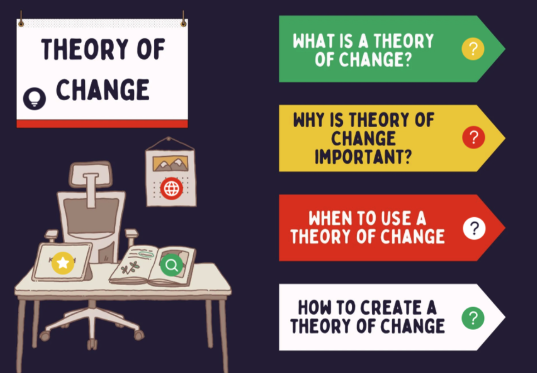
The multimodal design means our colleagues can navigate the guide in a non-linear, visually engaging way. Someone unfamiliar with a key term can hover over an icon for a brief definition, while others can jump straight to the example for inspiration: “The Thinglink resource is a great way of providing guidance on a copy of the actual form”. This user-friendly approach reflects our commitment to making evaluation both approachable, practical and accessible.
Scaling up: From project leads to campus-wide
As confidence grew among our initial cohort of APP project leads, we extended our support to provide one-to-one consultations. These conversations focused on clarifying logic chains and articulating realistic outcomes and timescales for projects.
We then scaled the training further by inviting both academic and professional services colleagues to attend, including staff working on our APP Innovation Fund (a seed-funding scheme supporting student-facing interventions targeting equality of opportunity). Seven applications from different schools were submitted, with four projects funded and are currently in delivery.
The innovation fund is a key vehicle for building institutional evaluation capacity: colleagues with less prior evaluation experience are now thinking rigorously about problem-solution logic and evidence.
Making it stick: Ongoing support and evolution
As the funded projects deliver, we’ll be supporting teams to use their theories of change iteratively, refining them as reality unfolds, tracking what assumptions hold and which shift, and collecting evidence of outcomes. We’re also working with our APP Strategy Group to embed theory of change thinking into institutional work more broadly.
Our intention is to continue rolling out training, support and TASO’s Theory of Change Builder, helping more colleagues build evaluation confidence. Through an ever-growing library of practical examples, guided practice, and accessible resources, we aim to further embed the theory of change approach across the entire institution.
Why this matters
Ultimately, our approach has helped empower our colleagues to understand that evaluation is not an intimidating hurdle but a powerful tool that sharpens thinking, strengthens interventions, and helps prove that reducing educational inequalities is within everyone’s reach.