News17 November 2026
Following today’s release of the Milburn Review, TASO sets out why higher education must remain front and centre in policy solutions to support more young people to learn or earn.
In response to today’s report Dr Omar Khan, CEO at TASO said:
“Today marks a pivotal moment for young people. Whether they are searching for a job, pursuing a degree or starting an apprenticeship, the Milburn Review outlines proposals to support each of these pathways with a full system reset.
“It’s also an opportune moment to remind ourselves of the transformative power of higher education in breaking down barriers to opportunity and driving social mobility for young people, particularly from the most deprived backgrounds.
“A university degree can help young people crack into a difficult jobs market and learn new skills in an increasingly complex world. A degree can give young people – and the broader UK economy – the edge needed to get ahead.”
Degrees can offer fast-track to jobs
New analysis from TASO reveals that undergraduate degree holders not in education, employment or training (NEET) are significantly more likely to be employed by age 24 than their peers with lower qualifications.
The analysis – based on Office for National Statistics data from Q1 2026 – shows that while university graduates tend to have a higher NEET rate at age 21, this trend quickly reverses. The NEET rate among degree holders nearly halves, falling from 16% at age 21 to 9% at age 24.
In contrast, the proportion of young people who are NEET with lower-level qualifications increases with age. By age 24, 38% of those with level 2 or below qualifications are classified as NEET. This is over four times the likelihood of university graduates being NEET at this age.
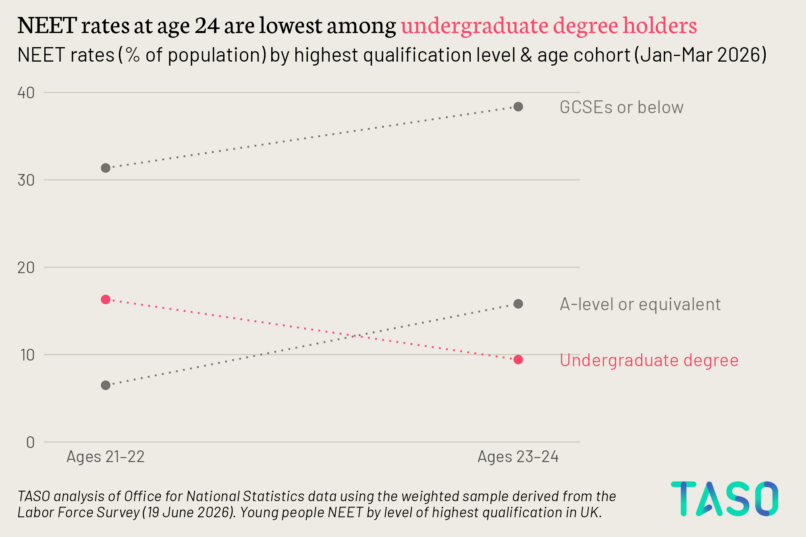
This chart shows the percentage of the population of 21-24 year olds who are NEET by type of highest qualification.
Graduate NEETs more likely to seek employment
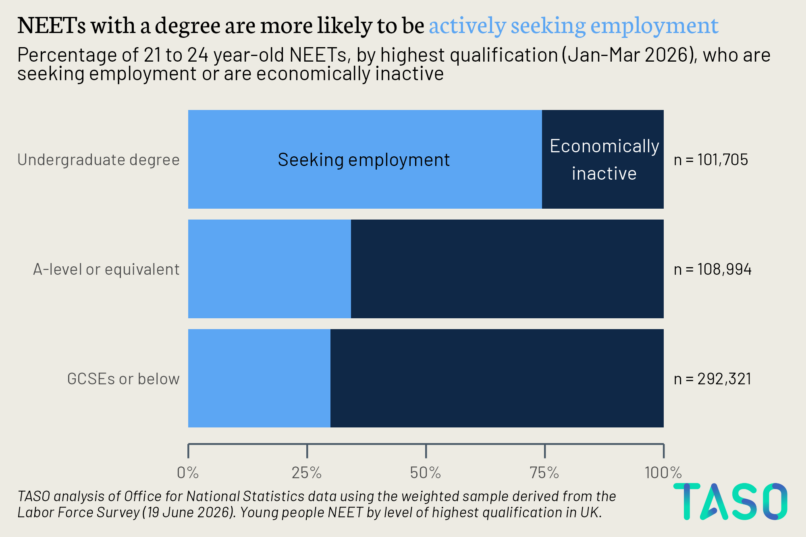
Degree-educated young people who are NEET are also more than two and half times more likely to be seeking employment than those who are NEET with GCSE-level qualifications or below. Only around one-third of young people who are NEET with lower qualifications are seeking employment, compared to three-quarters of those with an undergraduate degree.
The most disadvantaged reap rewards
According to Milburn’s Interim Report, young people from working-class backgrounds record a NEET rate of 22%, compared with 9% among those from higher professional backgrounds. The NEET crisis is therefore underpinned, in part, by social disadvantage and inequality.
While the report suggests further education is the natural ‘landscape’ for young people from low socioeconomic backgrounds with lower attainment, there are also well-evidenced benefits associated with attending higher education for the most deprived students.
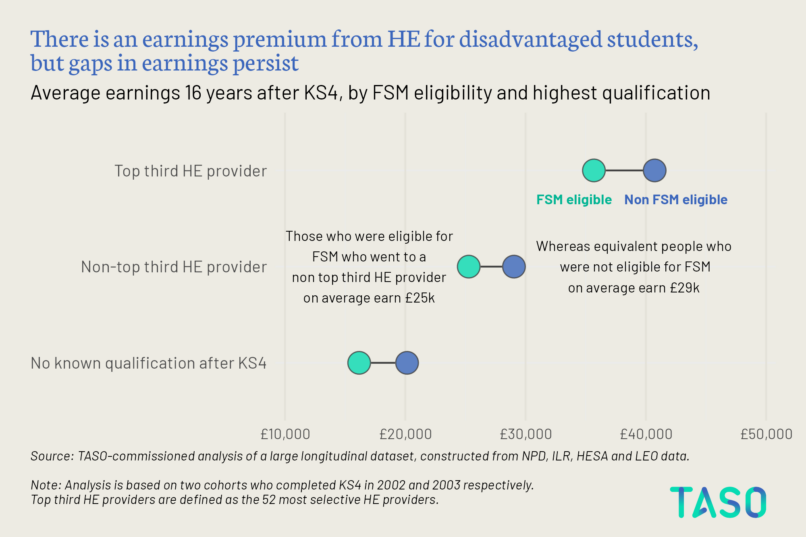
A TASO report analysed the earnings and employment status of more than a million individuals in England over 16 years post-GCSEs (exams taken at age 16). It found that disadvantaged and under-represented students clearly benefit from their qualifications, with those from free school meal (FSM) backgrounds seeing stronger labour market returns across every level of qualification.
Key considerations
- The findings of this new analysis point to how the broad category of ‘NEET’ masks significant variation in young people’s circumstances. Recent graduates looking for work for six months have different backgrounds and experiences from those with no GCSE qualifications, and therefore require a different policy response. Supporting all young people to achieve their potential in the labour market will require more refined data and analysis than using the umbrella ‘NEET’ category alone. There is scope within the Millburn Review’s proposed ‘Opportunity Guarantee’ for it to be delivered differently in response to the varied reasons why people are ‘NEETs’.
- The findings that graduates who are NEET are much more likely to seek employment and have stronger employment outcomes highlights the importance of supporting more mature learners to access higher education between the ages of 21 and 24.
- While further education pathways, apprenticeships, work experience and training all need strengthening, higher education must remain part of the policy solution to improve outcomes for all young people, particularly those from the most deprived backgrounds.
- There are already examples of higher education providers working effectively with further education colleges, and there is scope to deepen these links to provide young people with a range of educational and training opportunities.
- There remains a substantial higher education participation gap (around 20 percentage points) between FSM pupils and their more advantaged peers. Given that degree holders, including graduates from FSM backgrounds, are less likely to be NEET, closing the participation gap will help reduce the risk of people becoming NEET, and improve their labour market outcomes.
The analysis examined Office for National Statistics data from January – March 2026 – ‘Young people not in education, employment or training (NEET) by highest qualification, UK January to March 2022 to 2026’