Blog14 August 2026

Results day: better results, more participation; same old gap
Every August exam results are released. Each year, we see the media and the education sector respond by celebrating successes, noting disappointments, and recognising changes over time. But despite the changes, there is a certain déjà vu feeling in looking at the results in 2026. More sharply, could we draft our analysis and statements about the results before they are even released, with the message of the last two decades being on a clear and unmoving trendline?
In particular, for every year of this millennium (if not before), we see two trends for higher education participation: first, that participation has been increasing for everyone and for all demographic groups; and, second, that inequalities or gaps in participation rates remain stubbornly persistent, whether measured in terms of disadvantage or by region.
Deprivation gaps
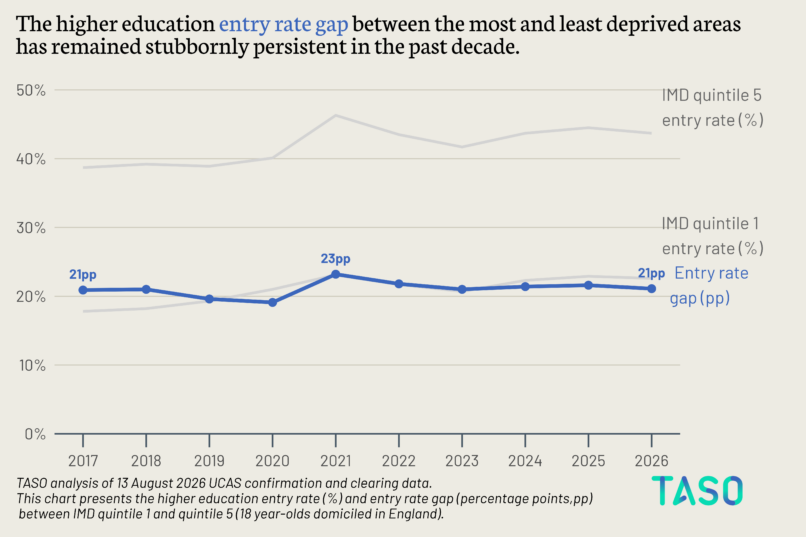
The graphs we’ve produced are based on UCAS data going back nearly a decade. In the case of gaps by the index of multiple deprivation, the story of ‘no change’ is obvious; the line is almost absolutely flat.
Regional gaps
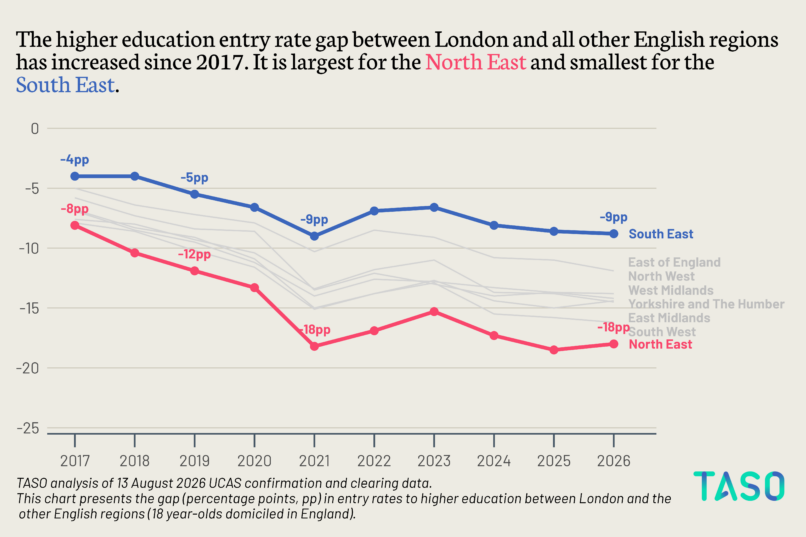
In the case of regional gaps, as measured by the gap between London and every other region, the story is a bit more complex. Over the past decade, there is a clear increase in the gap between London and the rest of the country. Looking more closely at the graph, we see this is driven by a sharp decline over the first period, and then a flatlining of the gap over time.
In this context, flatlining is not good news. Regional and socio-economic gaps are very wide, and the lack of improvement is sobering. Furthermore, if we look back further, say to 2006 or even 2001, we see that the gap between free school meal eligible pupils and their more advantaged peers hasn’t budged at all.
This means that we’ve made no progress on the gap in this millennium, or seven years before the current cohort of 18 year olds were even born.
Progress, positives and providers
It’s hard not to be dispirited by these results. There are, however, things that can address these participation gaps, from improving attainment in schools to nudging high attaining lower income children to apply more widely to universities. And it’s important not to ignore the very large expansion in the number of free school meal children going to university over the past two decades, a figure that has nearly doubled.
These aren’t just statistics: they represent tens of thousands of people who have had greater freedom to make choices, who have earned more in the labour market, and who report higher levels of wellbeing and provide greater security and freedom of choice for their own children.
There’s a lot more in the UCAS data, in terms of outcomes in different nations, by age (where mature learners have dropped by 22% since 2019), and by subject studied. One significant datapoint is the increase (up 34% since 2019) in places at higher-tariff providers, a smaller but still notable 17% increase in students at middle-tariff providers, compared to a 14% decrease in numbers among lower-tariff providers.
This aligns with data showing an increasing number of higher-tariff places being offered at reduced entry requirements of three Bs or lower. In this context, we recommend that providers consider access and participation as a priority when offering additional places, especially where entry requirements are reduced. Given free school meal pupils have lower prior attainment, the expansion of recruitment to include lowered entry requirements is an opportunity to address longstanding and persistent inequalities that have so far proven tough to shift.
Access and outcomes
The relative lack of progress is obviously a challenge to TASO, as well as the wider sector and the government. We know that more needs to be done to address inequalities of access, and know also that others, including the Social Mobility Commission, are looking at where there is some success.
TASO will continue to develop the evidence base on what works to address inequalities of access as well as of student outcomes, working with everyone in the sector committed to that aim. But we need to be clear-sighted and honest about the scale of the challenge – not just since our founding six years ago, but over many decades.
Not everyone will or should choose to attend higher education. There are deeper challenges in terms of ensuring all young people and adults have a wide range of options to enable them to thrive and participate in society, including in the labour market.
The test for TASO, the sector and indeed the government is to change these outcomes further. This day will always bring celebrations for some and disappointments for others. But those celebrations and disappointments should not be so stubbornly and predictably patterned, if we are to see stronger economic growth, fairer choices, and equal citizenship and participation for everyone, regardless of their background.
We need to do more than hope, but seek to change the analysis we produce on results day. To do so, we need better evidence on what works to tackle these gaps.
At TASO, we are refining our evaluation approach by prioritising early scoping, building stronger cross-sector partnerships for better implementation, and adopting more impactful approaches in terms of research methods and outputs.
Later this year, we will launch the Higher Education Evaluation Library (HEEL) – a central hub designed to share providers’ evaluations, foster peer learning, and develop a growing community of practice, with the ultimate aim of foregrounding what works to address equality gaps.
This flexible, responsive approach is vital to evaluating widening participation interventions effectively, helping the sector allocate resources to address the longstanding inequalities highlighted in the exam results published yesterday.