Blog23 June 2026

Recent media coverage has highlighted the difficulties some graduates face when entering the labour market. Young graduates interviewed by the BBC described submitting hundreds of job applications without success, struggling to gain experience and finding themselves caught between being underqualified for graduate roles and overqualified for lower-skilled work.
Findings from the British Social Attitudes survey suggest that public confidence in the value of higher education has fallen. However, the results show little evidence of widespread backlash against higher education itself. There is also a disconnect between public perceptions and graduates’ own experiences. Evidence suggests that the public tends to overestimate ‘graduate regret’, while graduates themselves generally report a more positive outlook about the value of higher education.
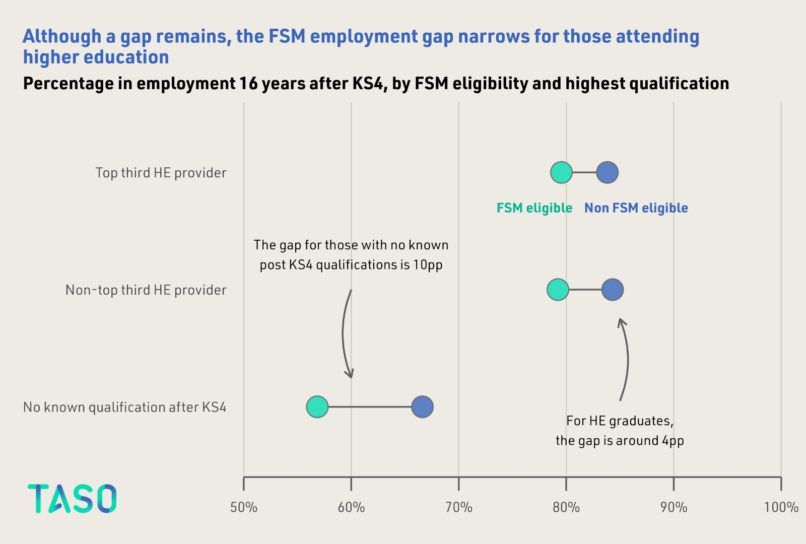
Alongside this, the value of higher education as a vehicle for social mobility is often absent from public debate. Longitudinal TASO research shows that graduates from free-school-meal backgrounds have better employment prospects than their non-graduate peers.
Among non-graduates, 57% of those in the free school meal cohort were in employment, compared with 67% of those not eligible for free school meals – a gap of 10 percentage points. Among graduates, this gap narrows to approximately four percentage points (with ~80% of free-school-meal graduates in employment, versus ~84% of those not eligible for free school meals), suggesting that higher education can help reduce inequalities in labour market outcomes.
More people question the value of a degree
The public debate is more focused on the overall financial value of a degree, regardless of students’ background. On this measure – whether a degree is financially worth it – public confidence has weakened considerably over the past two decades. In 2005, 50% of respondents agreed that graduates end up ‘a lot better off financially’ than those who do not go to university. By 2025 this had fallen to 36%. At the same time, the proportion of people who agree that a university education ‘just isn’t worth the amount of time and money it usually takes’ has more than doubled, rising from 14% to 34%.
Views on value for money have also become more negative. More than three-quarters of people (77%) believe that a university degree does not represent good value for money at current prices, up from 51% in 2014.
These results point to growing scepticism about the economic value of higher education, particularly at a time when graduates face rising costs and an increasingly challenging labour market. However, this scepticism in public opinion is not fully reflected in the evidence on labour market outcomes. TASO research finds obtaining qualifications post-Key Stage 4 is ‘clearly and unambiguously’ associated with increased earnings and likelihood of being in employment, compared with having no qualifications beyond KS4.
Graduates remain more positive than non-graduates
Despite this growing scepticism, graduates remain more positive about university than those who have not attended university. Just over one quarter (27%) of graduates agree that university is not worth the time and money, compared with 39% of non-graduates. A 2025 study by King’s College London confirms this perception gap, finding that just 8%of graduates wouldn’t go to university if they could choose again, whereas the public guess that this figure would be 40%.
Graduates are also more likely to believe that higher education improves people’s financial prospects. Nearly half (46%) agree that people who go to university end up a lot better off financially, compared with 32% of non-graduates. Similarly, graduates are more than twice as likely as non-graduates to disagree that university is not worth the time and money (36% compared with 17%).
While public confidence in the value of higher education has weakened overall, graduates themselves remain more positive about its benefits compared to those without direct experience of university.
Who is most sceptical about the value of a degree?
Views on the value of higher education vary across different groups. Younger people are generally more likely than older adults to believe that graduates are financially better off in the long run. Just over half (53%) of 16–24-year-olds agree with this statement, compared with 32% of those aged 70 and over.
Political differences are less pronounced when it comes to whether a degree is worth the time and money; around a third of Conservative (35%), Labour (34%) and Green Party (36%) supporters agree that university is not worth the investment. The figure is somewhat higher among Reform UK supporters (42%), while Liberal Democrat supporters are notably more positive, with only 20% agreeing.
The perception gap
However, one of the most interesting findings is that concerns about graduate outcomes do not necessarily translate into opposition to higher education itself. While only 18% of respondents overall think opportunities for young people to attend higher education should be reduced, 42% believe there are too many graduates in the labour market. This distinction is visible across the political spectrum. For example, only 13% of Labour and Liberal Democrat supporters think opportunities should be reduced, yet 40% and 43% respectively believe there are too many graduates. Even among Green Party supporters, only 11% support reducing opportunities, while one-third (33%) think there are too many graduates.
These findings suggest that many people continue to support access to higher education while questioning whether the current graduate labour market is delivering the outcomes graduates expect.
The challenge is confidence in outcomes
Public attitudes towards higher education have become less positive over the past two decades. Yet the survey suggests the debate is not about whether university should exist or who should attend. Instead, it is increasingly about whether higher education is delivering the financial and employment outcomes that many people expect.
The survey shows that fewer people are convinced that a degree automatically leads to better financial prospects than they were 20 years ago. At the same time, most people continue to support access to higher education, suggesting that concerns are focused less on university itself and more on the outcomes graduates experience after leaving it. This debate matters because higher education remains an important route to social mobility and reducing inequality.
TASO’s 2024 report on education pathways and earnings found that, 16 years after Key Stage 4 (KS4), people from disadvantaged backgrounds who attended higher education had substantially higher earnings than those with no qualifications beyond KS4. Those who attended the top-third providers earned over £20,000 more per year, and those who attended other higher education providers earned around £9,000 more.
The analysis also found that higher education is associated with improved labour market outcomes and can help narrow some inequalities, particularly in employment. However, disadvantaged graduates continued to experience poorer labour market outcomes than their more advantaged peers, indicating that higher education alone cannot eliminate wider inequalities in the labour market.
Improving labour market outcomes
The evidence suggests that higher education can help reduce inequalities in employment, narrowing the gap between those who were eligible for free school meals and those who were not. However, the same pattern is not seen for earnings, where a substantial gap remains in favour of those from more advantaged backgrounds.
And these are, of course, average outcomes; for a significant number of graduates, labour market outcomes are much less positive, and there’s a real risk of complacency where the majority are doing well.
Alongside efforts to widen participation, more work is needed to improve labour market outcomes for students and graduates. Strengthening employability support and addressing persistent inequalities in graduate outcomes will be important if higher education is to continue delivering on its promise as a driver of opportunity and social mobility.